Perspectives on AI in the Cybersecurity Industry in 2026
Join our experts as they discuss how AI has changed the security industry for better (or worse) and ways you can keep up with these rapid advancements.
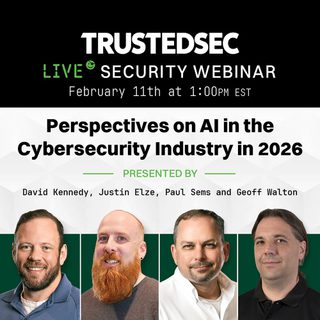
As we stand on the brink of unprecedented technological advancement, cybersecurity professionals face a critical question: Will AI be your greatest ally or your most formidable adversary? Join us for this exclusive webinar where our experts will decode the complex relationship between artificial intelligence and cybersecurity in 2026.
Our experts will discuss:
- Future AI Trends - The revolutionary AI technologies that will dominate cybersecurity strategies
- Emerging Threats - The sophisticated attack vectors that AI-powered adversaries will deploy
- AI-Driven Solutions - Cutting-edge defensive technologies that will define cyber resilience
Join TrustedSec Founder and CEO David Kennedy, CTO Justin Elze, Managing Director of Remediation Services Paul Sems, and Application Security Practice Lead Geoff Walton as they dive into how AI is changing the digital world. They will discuss how these emerging technologies have changed the security industry for the better (or the worse) and ways you can keep up with these rapid advancements. Don’t miss out on these key insights from distinctive viewpoints in security.
Webinar Summary
Perspectives on AI in the Cybersecurity Industry in 2026
Featuring: Dave Kennedy (Founder & CEO), Justin Elze (CTO), Paul Sems (Managing Director, Remediation Services), and Jeff Walton (Practice Lead, Application Security)
AI has moved past the hype cycle. In this webinar, TrustedSec's leadership breaks down what AI actually looks like in practice across offensive security, enterprise deployment, threat detection, and defensive operations heading into 2026.
The conversation covers where AI is making a measurable difference for security teams, where the technology still falls short, and what organizations should be prioritizing right now to avoid the governance and data exposure pitfalls that are already causing problems in production environments.
What the Panel Covers
- AI in offensive security operations. Justin Elze and Dave Kennedy discuss how AI is changing penetration testing and red team workflows. The panel walks through what is actually being automated today (reconnaissance, asset discovery, architectural mapping), where autonomous pen testing tools like Horizon3 AI fit in the landscape, and why the creative post-exploitation work that defines a skilled operator is still beyond what current models can do. Justin also raises a critical point about open-source pen test agent frameworks that blindly trust scan output, creating a prompt injection attack surface that most teams have not considered.
- Enterprise AI deployment and the Copilot problem. Paul Sems addresses the business side of AI risk, specifically what happens when organizations turn on Microsoft Copilot without proper data classification and segmentation in place. The panel shares real scenarios where employees discovered sensitive information about layoffs and compensation simply by asking Copilot a question. Paul ties this back to fundamentals: if you do not have your governance structure, data classification, and network segmentation in place, AI tools will surface information they should not, and users do not need to be hackers to find it.
- AI-powered threat detection and SOC automation. Dave Kennedy walks through NightBeacon, the AI solution he built for TrustedSec's sister company Binary Defense. The discussion covers how the tool performs contextual analysis rather than pattern matching, how it retrains incrementally based on individual analyst expertise so the entire team benefits from shared knowledge, and how it has reduced analyst investigation time from twenty to thirty minutes per ticket down to roughly two minutes. The panel also discusses the current state of autonomous SOC tools and why most of them still have high false positive rates due to poor data quality.
- Deception technology and AI. The panel makes a strong case for deception as one of the most underutilized capabilities in cybersecurity. Dave describes how Binary Defense's Vision Agent uses AI to generate realistic deception artifacts that mirror the actual environment, including honey credentials, fake SPN accounts, LLMNR/NBT-NS traps, and simulated network topography. The team discusses upcoming capabilities including dynamically isolating confirmed attackers into simulated environments for intelligence gathering.
- AI governance and the vibe coding problem. Dave and Justin discuss the security implications of AI-assisted development, including the verbosity and complexity of vibe-coded applications, exposed API keys in AI-generated code, and the supply chain risk created by developers pulling in unvetted skills, MCP servers, and browser plugins. Jeff Walton adds that the proliferation of low-code and no-code tools means SOC teams should prepare for an increase in investigations as non-technical employees start building scripts and automations that trigger anomalous activity alerts.
- The AI market and business model sustainability. The panel closes with a candid assessment of the AI industry's financial reality, including the gap between venture capital valuations and actual profitability, the infrastructure costs that make current pricing models unsustainable without subsidization, and the likely consolidation of AI capabilities into major corporations like Microsoft and Google that can absorb those costs.
If you have questions about any of the topics covered or want to learn more about how TrustedSec are applying AI across offensive and defensive security operations, contact our team.