Updating the Sysmon Community Guide: Lessons Learned from the Front Lines

Table of contents
Over the past few weeks I’ve been spending a significant amount of time updating the Sysmon Community Guide. This wasn’t driven by theory, trends, or what 'should' work on paper. It was driven by what we keep seeing over and over again in real Incident Response engagements.
The timing also happens to line up with an announcement many of us never expected to hear: Mark Russinovich confirmed that Sysmon will be integrated into Windows 11 and Windows Server 2025 going forward.
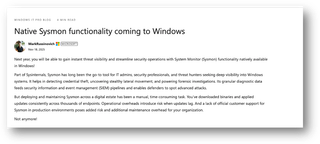
While Sysmon still won’t be enabled by default, this announcement signals a shift in how endpoint telemetry is being treated—and it reinforces why getting Sysmon right matters now more than ever.
But the guide update itself wasn’t about that announcement. It was about everything we’ve learned about deploying, tuning, breaking, fixing, and relying on Sysmon when it actually matters.
Why the Guide Needed an Update
I’ve been writing about, teaching, and deploying Sysmon since the early versions, and despite how powerful it is, one of the most persistent frustrations I still run into during Incident Response is the lack of usable telemetry.
In many environments:
- Customers overinvest in AV or EDR and assume visibility is 'covered'.
- Default Windows event logs aren’t forwarded anywhere.
- Linux auditd logs sit locally and never make it to a SIEM.
- Or, auditing is enabled, but everything is collected and forwarded indiscriminately.
The result is usually the same…too much data and very little signal.
Teams pay for massive storage, yet investigations slow down. Detections become unreliable. Analysts drown in noise. This isn’t a tooling problem—it’s a configuration and design problem.
Sysmon, when configured intentionally, enables teams to be targeted and deliberate. It allows you to decide what actually matters, collect only that data, and forward it in a way that supports detection engineering, threat hunting, and Incident Response. The guide update focuses heavily on that reality.
Lessons from Real Incidents and what was Updated
This update incorporates lessons learned from:
- Active Incident Response cases
- Ransomware investigations
- Nation-state activity
- Tabletop Exercises
- Playbooks/Runbooks we’ve helped customers build and refine
- Continuous collaboration with Detection Engineers and our Purple Team
One of the biggest additions is a new Detection Engineering Fundamentals section. This chapter isn’t Sysmon-specific for the sake of it—it emphasizes how telemetry should be used, not just collected.
We cover:
- Why Sysmon configuration matters
- How poor configurations destroy signal-to-noise ratio
- How to focus on log value instead of log volume
- Why Sysmon is only one layer in a defense-in-depth strategy
But Sysmon alone is not enough. As the old saying goes: one is none, two is one. The more well-designed telemetry sources you feed into your SIEM, the better your detections and investigations will be.
Every chapter in the guide was revisited and refreshed. Updates include:
- Clearer guidance on configuring each Sysmon event type
- Mapping to MITRE ATT&CK techniques
- Practical recommendations focused on getting value, not just data
- Emphasis on tuning Sysmon to support detection engineering, not overwhelm it
Another important aspect we address—very directly—is the reality that Sysmon has historically not been officially supported. Over the years, this has led to real-world issues, including performance problems, driver incompatibilities, and in some cases system instability.
Because of that, the guide continues to stress:
- Testing before broad deployment
- Rolling changes out in stages
- Keeping archived versions available for rollback
These aren’t academic concerns—they come directly from environments where things went wrong and teams had to recover quickly.
Closing Thoughts
Sysmon’s integration into Windows 11 and Windows Server 2025 is important, but that alone won’t close visibility gaps. The real value comes from understanding why you’re collecting data, what you should collect, and how to use it effectively.
This guide update reflects lessons learned the hard way—through incidents, investigations, and real-world failures. My hope is that it helps teams avoid common mistakes and get meaningful value out of Sysmon—both now and in the future.
Going forward, each major update to the guide will include a refreshed PDF, available both through GitHub releases and directly from TrustedSec.
You can find URLs for the updated guide here:
- TrustedSec Sysmon Community Guide (GitHub):
https://github.com/trustedsec/SysmonCommunityGuide - TrustedSec Sysmon Community Guide (TrustedSec site):
https://trustedsec.com/resources/tools/trustedsec-sysmon-community-guide